

eCommerce SEO Checklist: Complete Guide to Grow Your Online Store in 2026 – 2027
Introduction
Running an eCommerce business today is not just about listing products and waiting for sales. The competition is massive, and customers are smarter than ever.
In 2026, SEO (Search Engine Optimization) is no longer optional—it’s the backbone of any successful online store.
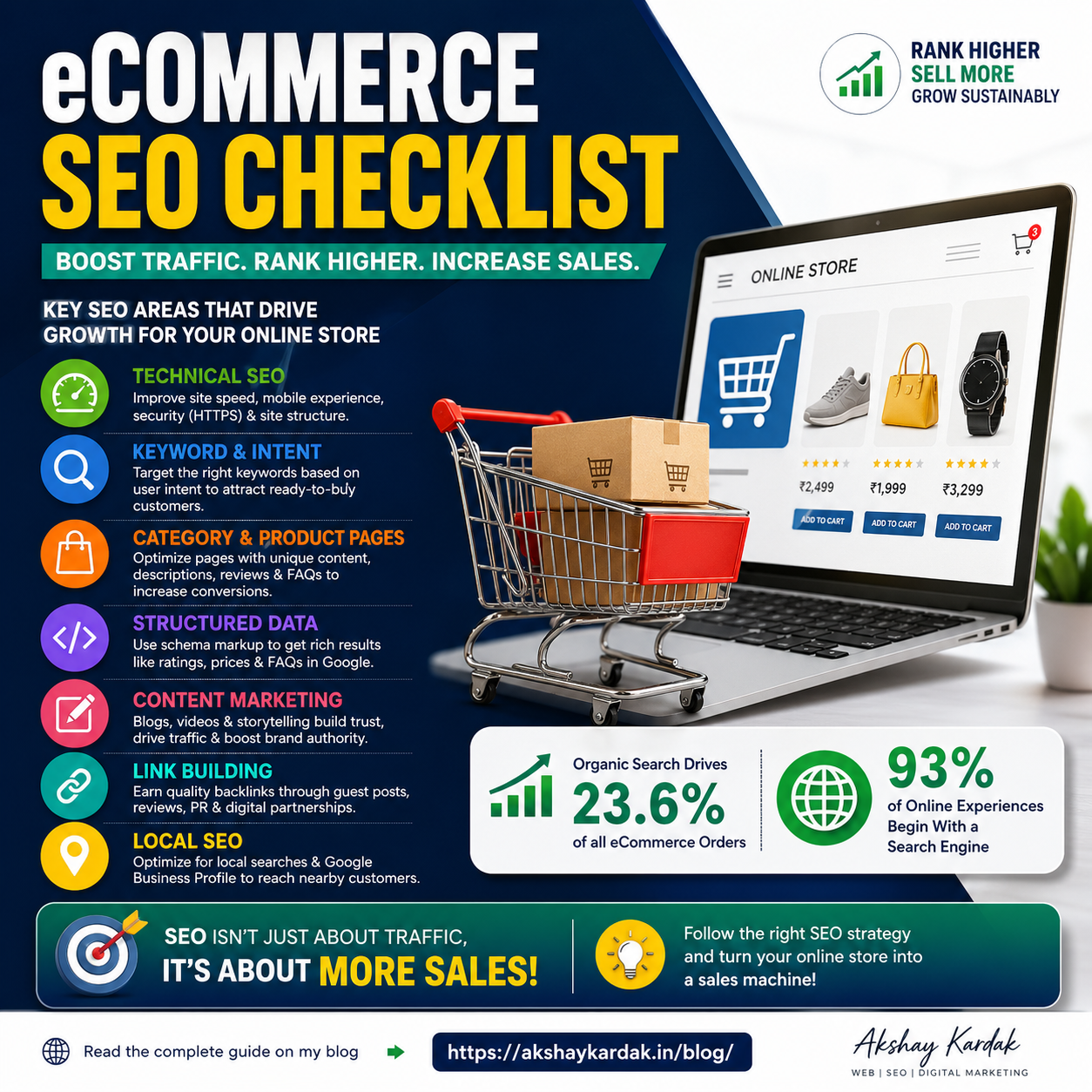
Global eCommerce sales are expected to cross $7.95 trillion by 2027, and most customers still start their buying journey on search engines. In fact, around 93% of online experiences begin with a search engine, and organic search contributes to nearly 23.6% of all eCommerce orders.
That means if your website is not ranking on Google, you’re missing out on serious revenue.
This blog will walk you through a complete eCommerce SEO checklist, covering everything from technical setup to content, conversions, and future trends—especially useful if you’re running a business in India or targeting Indian customers.
1. Understanding the Current eCommerce Landscape (2025)
The digital market is evolving fast, and two major trends are shaping eCommerce SEO:
📱 Mobile-First Dominance
- Around 78% of traffic comes from mobile devices
- Nearly 68% of purchases happen on smartphones
👉 If your website isn’t optimized for mobile, you’re already behind.
🤖 AI Integration
- Businesses are using AI for supply chain and personalization
- Search engines now show AI-generated answers (Google AI Overviews)
👉 This means your content must be clear, structured, and authoritative
2. Technical SEO: The Foundation of Your Website
Before anything else, your website must be technically strong.
Core Web Vitals (Very Important)
Google measures user experience using:
- LCP (Largest Contentful Paint) → loading speed (< 2.5 seconds)
- INP (Interaction to Next Paint) → responsiveness (< 200 ms)
- CLS (Cumulative Layout Shift) → visual stability (< 0.1)
A faster website can increase conversions by up to 17%, while slow sites lose users quickly.
How to Improve:
- Use fast hosting (important in India due to latency)
- Enable caching & CDN
- Compress images (use WebP format)
- Load scripts only when needed
Website Security (HTTPS is Mandatory)
- Your site must have an SSL certificate (HTTPS)
- Around 92% of eCommerce sites have security issues
👉 A secure website builds trust and improves rankings.
Site Structure (Very Important for SEO)
Your website should follow a simple structure:
Home → Category → Subcategory → Product
This helps:
- Users navigate easily
- Google understand your website
SEO-Friendly URLs
Bad URL:example.com/product?id=123
Good URL:example.com/mens-shoes/running-shoes
Best Practices:
- Keep URLs short
- Use keywords
- Use hyphens (-), not underscores
Breadcrumbs (Small but Powerful)
Breadcrumbs help users and search engines understand your page hierarchy.
Example:
Home > Shoes > Running Shoes > Nike Air Max
They also improve your appearance in Google search results.
Handling Filters (Faceted Navigation)
Filters like:
- Price
- Size
- Color
can create thousands of URLs and confuse Google.
Solution:
- Use canonical tags
- Add noindex for unnecessary pages
- Block useless parameters in robots.txt
3. Keyword Research Based on Intent
Modern SEO is not about keywords—it’s about user intent.
Types of Search Intent
1. Transactional (Ready to Buy)
Example:
“Buy shoes online India”
👉 Optimize product pages
2. Commercial (Comparing)
Example:
“Best shoes under ₹3000”
👉 Optimize category pages or blogs
3. Informational
Example:
“How to clean shoes”
👉 Write blog content
4. Navigational
Example:
“Adidas official store”
👉 Optimize homepage
Pro Strategy:
🔍 Competitor Gap Analysis
Find keywords your competitors rank for—but you don’t.
🎯 Striking Distance Keywords
Keywords where you’re ranking on page 2 → push them to page 1 with small improvements.
4. Product Page & Category Page Optimization
Category Pages (High Revenue Drivers)
Category pages often generate 3–5x more traffic and revenue than product pages.
Best Strategy:
- Add short intro (50–100 words) at top
- Add detailed content (200–300 words) at bottom
Product Pages (Conversion Focus)
Most businesses make one big mistake:
👉 Copy-pasting manufacturer descriptions
But 87% of users depend on product descriptions before buying.
What to do:
- Write unique descriptions
- Focus on benefits, not just features
- Add:
- Reviews
- Ratings
- FAQs
E-E-A-T (Very Important for Google)
Your site should show:
- Experience
- Expertise
- Authority
- Trust
👉 Add real reviews, testimonials, and detailed content
5. Structured Data (Schema Markup)
Schema helps Google understand your content better.
Important Schema Types:
- Product schema (price, availability)
- Review schema (stars in search results)
- FAQ schema
- Breadcrumb schema
👉 This can increase CTR by up to 35%
6. Content Marketing & Storytelling
Content helps bring traffic at every stage.
Use Video Content
- Product demos
- Tutorials
- Customer reviews
👉 Improves engagement and conversions
Use Storytelling
Instead of:
“Leather shoes with rubber sole”
Say:
“These shoes are perfect for long office hours and daily wear…”
👉 Storytelling can increase perceived value massively and improve conversions.
Blogging Matters
Businesses with blogs get 55% more traffic.
👉 Write blogs targeting Indian audience:
- “Best budget shoes in India”
- “Top eCommerce platforms in India”
7. Link Building (Authority Growth)
Backlinks = Trust signal for Google
Best Strategies:
- Guest posting
- Influencer collaborations
- Product reviews
- Digital PR
Smart Techniques:
- Fix broken links
- Convert brand mentions into links
- Get featured in “Top products” lists
8. Choosing the Right Platform (Important Decision)
Popular platforms:
- Shopify → Easy but limited control
- Wix → Beginner-friendly
- WooCommerce → Full control (best for SEO)
👉 WooCommerce is ideal if you want:
- Full SEO control
- Customization
- Better long-term growth
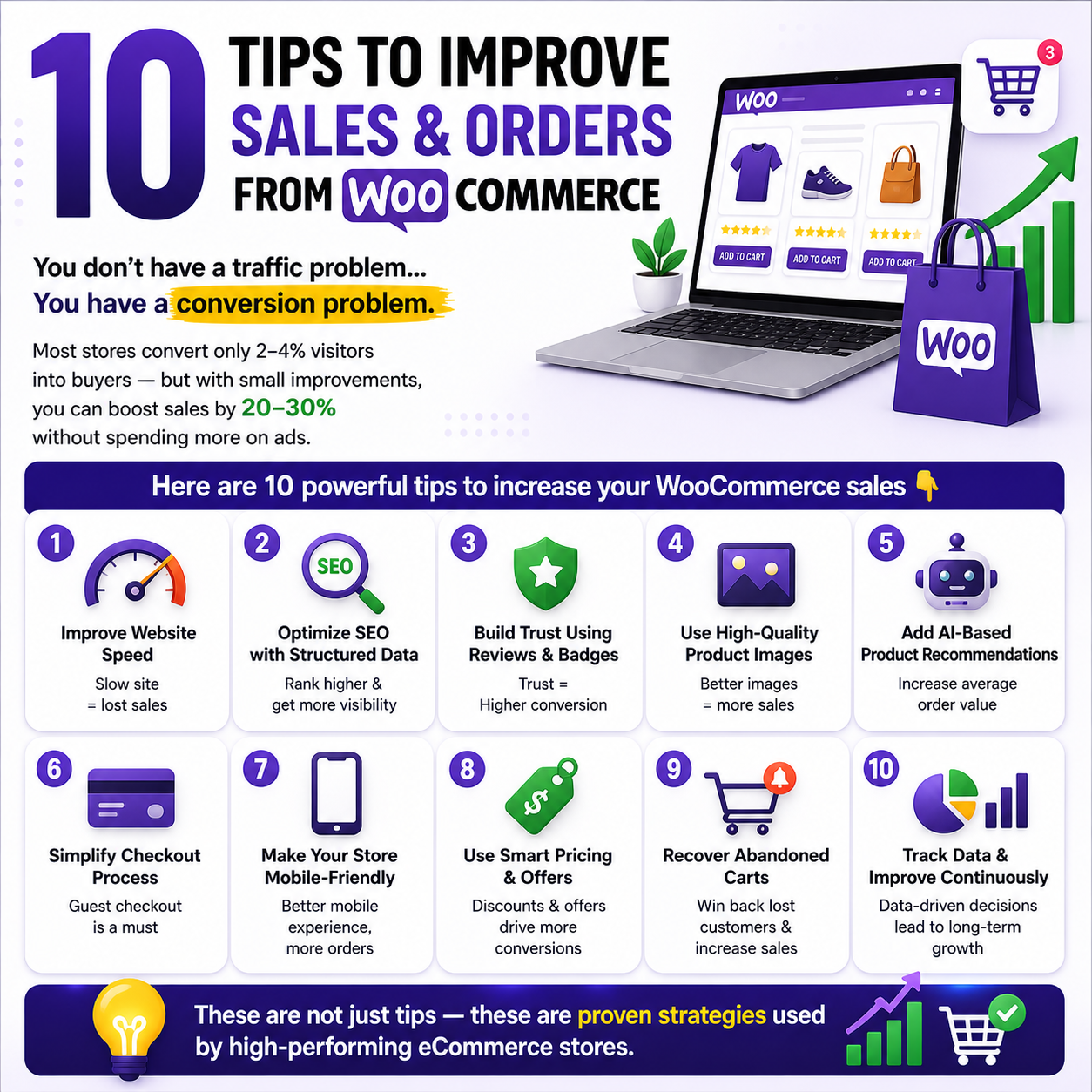
9. Conversion Optimization (Very Important)
Getting traffic is useless if users don’t buy.
Big Problems:
- 70% users abandon carts
- High delivery charges
- Complicated checkout
How to Fix:
- Improve site speed
- Simplify checkout
- Show trust badges
- Offer COD (important in India)
- Use personalized recommendations
10. Local SEO for Indian Businesses
If you target specific cities:
Do This:
- Create city-based pages
- Optimize Google Business Profile
- Use keywords like:
- “online store in Nagpur”
- “best ecommerce website India”
👉 Around 72% of users search for local businesses online
11. Future of SEO: AI & GEO (Very Important)
Search is changing fast.
- AI answers reduce clicks
- 27% searches end without clicks
- CTR is dropping
What to Do:
✅ Focus on “Best Answer” content
✅ Build strong authority
✅ Aim for top 3 rankings
12. Tracking & Improvement (Don’t Skip This)
SEO is not one-time work.
Track:
- Organic traffic
- Conversion rate
- Keyword rankings
- Cart abandonment
Tools:
- Google Search Console
- Google Analytics
👉 Regular audits help avoid issues like broken links or errors.
Conclusion
eCommerce SEO in 2025 is a mix of technical strength, high-quality content, and smart strategy.
It’s not about shortcuts anymore. It’s about:
- Giving users the best experience
- Providing real value
- Building trust
If done correctly, SEO can become your biggest source of sales and long-term growth.
Need Help with Your eCommerce Website?
If you’re planning to build or optimize your eCommerce website (especially using WordPress + WooCommerce), I can help you with:
- Complete SEO setup
- Website optimization
- Speed improvement
- Conversion-focused design
👉 Let’s turn your website into a sales machine